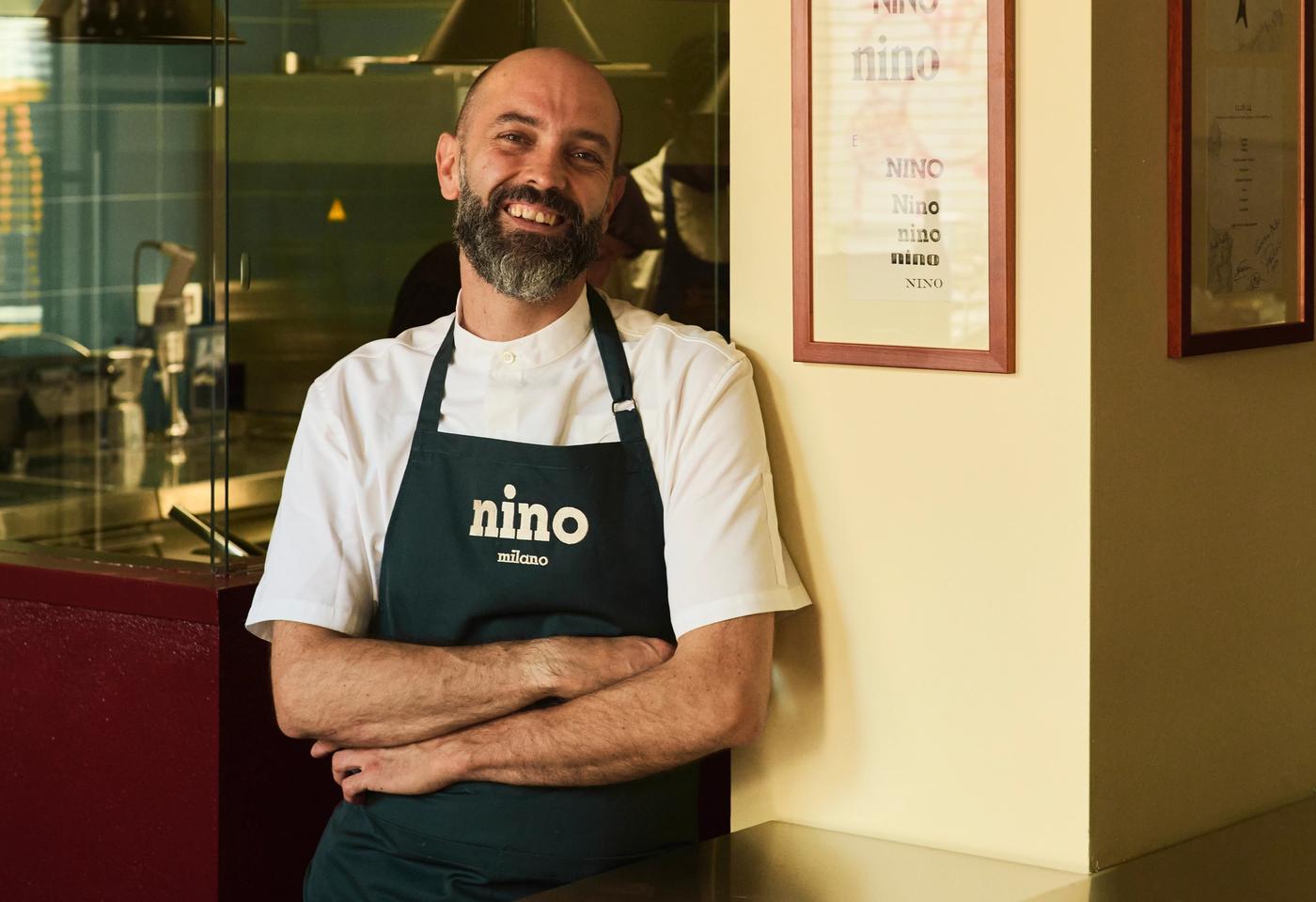
“In Italian culture, people want to eat—it’s culture, it’s sociality. There are no longer public spaces where people can gather; it used to be community centers, now people meet in bars and venues, but real gathering places are missing.”
That is how our conversation with Vladimiro Poma begins, and for those who aren’t familiar with him, let us refresh your memory. For years, he was a key pillar and sous-chef to Cesare Battisti at Ratanà, before going on to lead the kitchen at Silvano Vini e Cibi in NoLo. Now that we know a bit more about him (we’re being ironic, of course—you should go to Sorelle Poma and meet him in person; yes, that’s actually what the place is called).

“Silvano started out with a specific idea: Milan is built by people from the provinces (whether it’s the province of Syracuse or Bergamo), and I needed something rooted in everyday culture that would break the rules of classic Milanese philosophy. We all know the neighborhood tavern and corner bar, which is why the toasted sandwich was born—I wanted to create something that existed in everyone’s shared imagination.”
Milan is a city of arrivals. For years, it was a dream for many: the place to launch a career, the city that promised everything. For decades, the mantra was that Milan gives you everything, in Milan you can do anything. In some ways, that may have been true, but today the question is: how much of that “everything” can you actually afford to do? How high has the real cost of this city become—and we aren’t just talking about the cost of living. So, reversing a trend that spanned decades of Milanese history, people are moving out toward the provinces. In everyone’s memory, the province represents a return to one's roots, to that home left behind to chase a dream, to a dish that tastes like family.

“We didn’t invent anything with Silvano; modern taverns were already popping up, but they were all about 'product'—they lacked someone actually cooking. Silvano only had a bread oven, but I wanted to cook. That gave birth to SORELLE POMA. I wanted to get back to real cooking, because storytelling is nice at first, but then it becomes a drag. So we came up with the idea of two distinct identities: the trattoria and the osteria. No reservations! You walk in, and if there’s a table, you sit down; if not, you come back later: WHEN THE F*** HAVE YOU EVER MADE A RESERVATION AT AN OSTERIA?”
Now back to Milan, because Sorelle Poma is very much about this dynamic. This new spot, which draws a line outside before the doors even open, is located in LAMBRATE—a neighborhood not far from the wildly popular NoLo. Lambrate is driven by regulars, people who still get their morning coffee at their trusted neighborhood bar rather than an Instagrammable café, people who still shop at a traditional bakery. It’s also an urban fabric facing issues like drug dealing, loitering, and a sense of insecurity, especially at night.

“NoLo has become a culinary destination; the neighborhood thrives on it now. Lambrate, on the other hand, belongs to regulars—people who have always spent time here. Locals. I tell them: I’ve built you the private lounge of NoLo, because everyone who goes to NoLo actually lives right here. We have the Birrificio di Lambrate, Nora No Drunk—we were the missing piece. There wasn’t an Italian restaurant in the area doing modern cuisine—not gourmet, but a restaurant driven by real ideas and thought. There are places where only tourists and foreigners eat (which is just an observation, not a complaint), so a genuine gathering spot was needed.”
That is where SORELLE POMA comes in. The name deserves an explanation because it embodies both the osteria and the trattoria. On one side, the osteria—the small-town tavern capable of welcoming puritans, communists, and non-conformists alike. On the other side, the trattoria—the classic spot where families gathered for lunch or dinner. Vladimiro and his sister combined these two entities into a single ecosystem in a neighborhood where an espresso still costs €1.30.
“Milan is always reinventing itself: different needs, different jobs, different cultures. Everything that lands here has to be distinct. To me, the trattoria has bourgeois roots—before becoming a place for workers, it was for families having lunch. At Sorelle Poma, both spirits coexist with two clear identities. The Trattoria will feature two set menus—surf & turf and a vegan/gluten-free option, because so many people have dietary intolerances today. We’re in hospitality; we have to make everyone feel welcome.”
In a city where control reigns supreme, where grabbing a drink with a friend requires checking calendars and sending calendar invites, where eating at a restaurant means booking a month ahead because if it’s not sold out it isn’t cool, we love the total refusal of reservations. If you show up and find a table, great; if not, tough luck. It puts everyone on the exact same footing—no shortcuts, no status plays, because sometimes we need to be reminded that none of us are special.
“With our no-reservations policy, we’ve weeded out the entitled crowd. Most complaints come from people upset they can’t book ahead, but that clears out the people who don't have time to take their time. What kind of mindset are you going out with? What are you trying to do? It’s not a race!”
Which brings us to a topic close to the hearts of native and converted Milanese alike: time. We no longer have time, or perhaps we’ve lost the ability to take it. Look at the screen-time reports on your phone—and ours—and you’ll find hours spent on TikTok and Instagram that account for all the time we claim not to have.
“I was born in Bordighera and lived in Milan until I was 10, when my family moved back to Liguria. I have a deep connection to Liguria; we come from a tiny village in the hinterland of Imperia with 65 residents—if you want to disappear, nobody can find you there. My dream is to open a spot there, working with wild herbs, rabbit, local cheeses... Life moves slowly there, and you can run a place that closes for the winter. Taking your time is hard when control is involved—the need to ensure everything is done your way, the struggle to ask for help or delegate. It’s deeply personal work, but you can only delegate so much. You pour yourself into it because it’s right, because you want to give something of yourself to others. It’s rewarding to be hands-on; otherwise, it all feels too cold. I have huge respect when I see a real chef at the stoves. Being present in the kitchen and standing alongside your team matters. There are moments when you must be there and moments when you need to step back. The food speaks your language—the kitchen speaks the language of whoever is in it.”
You won’t find a breakdown of the menu at SORELLE POMA in this article, nor a detailed review of the wine list or the technique behind every dish. Certain places have to be experienced firsthand, with an open mind. All we’ll say is that at least once a week, we drop by this trattoria/osteria to get grounded again.